After a year's break in 1955 due to the accident tragedy at the 24 Hours of Le Mans, the Grand Prix of Germany took place at the Nürburgring on 5 August 1956, and was simultaneously the seventh race of a total of eight championship rounds of the 1956 Automobile World Championship.
At this point, British racing driver Peter Collins led the drivers' standings with a one-point advantage over Juan Manuel Fangio, both under contract with Scuderia Ferrari, and a four-point advantage over Jean Behra, who was racing for Maserati. All three therefore still had good chances of winning the drivers' world championship title. Stirling Moss, another title contender, was already well behind at this point, so he could only hope for a title chance if his rivals were set back by retirements.
In the race itself, the Italian teams Ferrari and Maserati set the tone and were among the most promising contenders for victory. Besides Fangio and Collins, Ferrari also fielded Eugenio Castellotti, Luigi Musso and Alfredo de Portago. At Maserati, victory was expected above all from their star drivers Stirling Moss or Jean Behra. The remaining drivers, Cesare Perdisa and Paco Godia, completed the Maserati racing team. As a third competitor, the French racing team Gordini entered the race with two cars. The Scuderia Centro Sud team with a Maserati 250F and a Ferrari 500, along with six further drivers in private cars, completed the field of entrants.
Following Ascari's fatal accident shortly after the 1955 Monaco GP, combined with concurrent financial difficulties, the Lancia racing team, with all its cars along with the inventory and development know-how, was taken over by Ferrari in 1955. Ferrari then immediately began fundamentally reworking the Lancia cars and implemented many new innovations. As a result, a new era began at Ferrari from 1956 onwards.
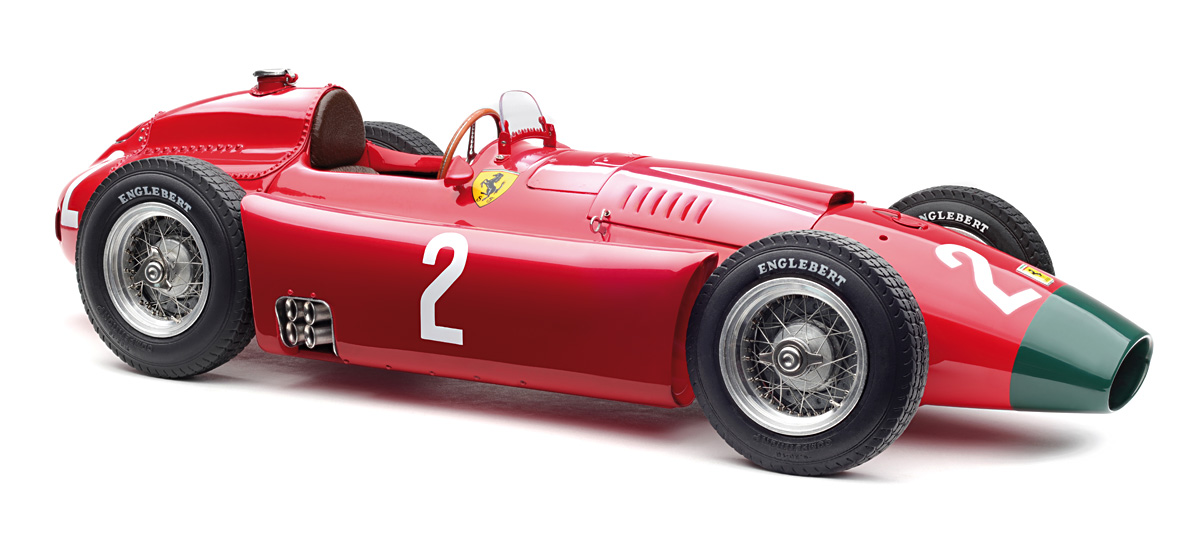
At the Grand Prix of Germany, the further-developed cars were consequently fielded under the designation Lancia-/Ferrari D50 (later the shortened designation Ferrari D50 was predominantly used).
Ferrari's star driver Juan Manuel Fangio started with a car fitted with a long nose. His teammate Peter Collins also took to the race with the same car specification. The long car nose gave the cars a striking appearance with streamlined bodywork characteristics. A blue/yellow stripe painted at the nose tip helped make Fangio's car easier to identify during the race. For distinction, Collins' car had a green stripe at the nose tip.
As expected, Fangio, with start number 1 and the registration marking MO·36 on the rear left of the tail, took pole position with a time of 9:51.2 min ahead of his teammate Collins. The two championship contenders Fangio and Collins were separated by just three tenths of a second. Castellotti took third place on the grid, three seconds behind. Maserati driver Stirling Moss qualified in fourth place, a further ten seconds behind the Ferraris.
The race over 22 laps of 22.81 km each, with a total distance of 501.82 km, began promisingly for Ferrari. Even before the first corner, Collins managed to take the lead. However, he was overtaken by Fangio already in the first lap, who thus took the lead of the field and did not relinquish it again until the end of the race. During the race, Fangio and Collins repeatedly improved the 17-year-old track record, which Fangio improved to a new record time of 9:41.6 min. Unfortunately, Collins crashed during the race due to a driving error and had to retire. In the end, only seven drivers finished the race. Fangio won comfortably with a 45-second lead over Stirling Moss, who crossed the finish line in second place a few seconds ahead of Maserati driver Behra.
The clear winner of this race was undoubtedly Juan Manuel Fangio, who claimed pole position, victory and the fastest race lap. In the drivers' standings, Juan Manuel Fangio once again took the lead and went into the season finale at the still-outstanding Italian GP in Monza with an eight-point advantage.
CHF 570.-