Hill climbs have always offered a welcome change of pace in motor racing. They were already popular back in the thirties, not least because genuine Grand Prix racing cars were used. Auto Union held a special position here with its Type C racer, having in Hans Stuck an excellent driver at the wheel who, thanks to his numerous victories, was crowned the famous "Hill King".
Internationally renowned was the legendary Schauinsland hill climb near Freiburg. The first race was held there in 1925. In the years that followed, the race developed into an international competition and, during the golden era of the Schauinsland hill climbs in the thirties, often drew more than 20,000 spectators to Freiburg's local mountain.
The same was true on 1 August 1937, when the 13th Schauinsland race for the Grand Hill Prize of Germany was held. An illustrious entry list from 10 nations was on hand. Leading the field were the two top works teams of Auto Union with their star drivers Hans Stuck and Bernd Rosemeyer, as well as Mercedes-Benz with drivers Rudolf Caracciola, Manfred von Brauchitsch and Hermann Lang. The 12 km course climbed up to the Schauinsland pass summit, taking in 178 corners and 780 metres of altitude gain, with gradients of up to 12% in places.
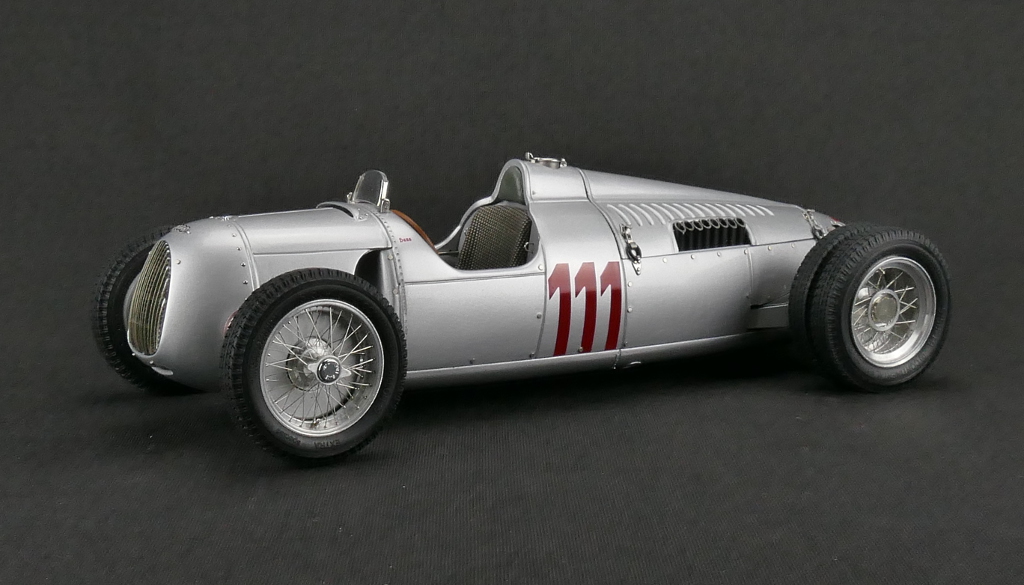
At the end of the race, as so often, it was the old master and Hill King Hans Stuck who once again came out on top, winning in his Auto Union Type C with twin rear wheels and start number 111, narrowly ahead by one second of his teammate Bernd Rosemeyer, also driving a Type C but with single rear wheels. Mercedes came off worse that day. Rudolf Caracciola and Hermann Lang, each driving a W125, took third and fourth place.
To better put the immense engine torque down onto the road, the drive axle was often fitted with four wheels at the time. This had a beneficial effect on traction and made the high loads in the tight mountain corners easier to control. But ultimately it wasn't always engine power that decided the race — driving skill, and above all the driver's cornering technique, was called for and proved decisive for victory. In some cases, for classic hill climbs the Auto Union racers had a shortened chassis and a smaller fuel tank with an internal filler neck. Original data on this was not available.
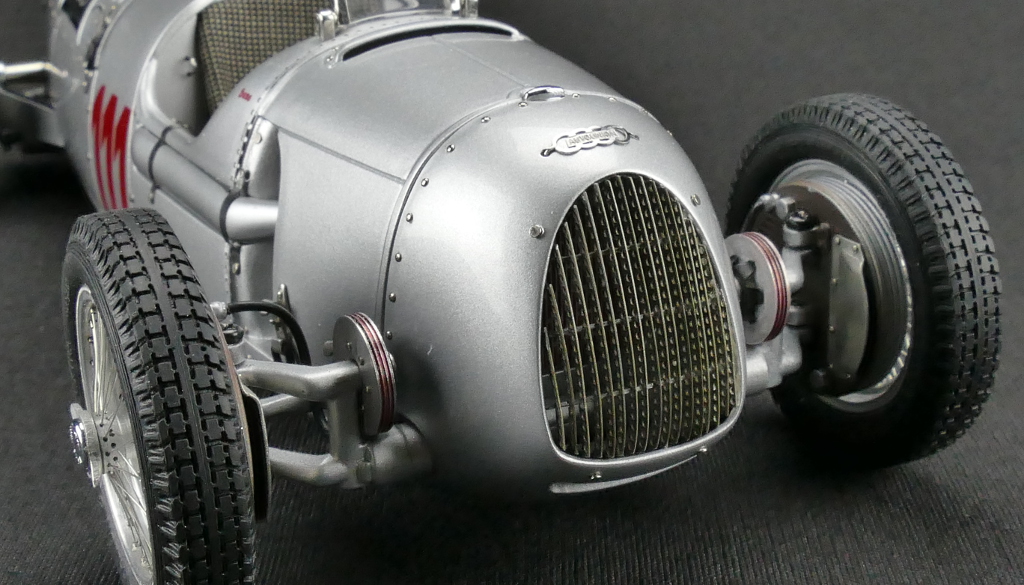
The CMC hand-assembled precision metal model represents Hans Stuck's winning car with start number 111 and twin wheels on the rear axle. The Auto Union Type C is hand-assembled from 1,301 parts into a precision model of the highest calibre. The individual parts are made from high-quality materials: 23 parts are die-cast zinc, 754 are metal, copper or photo-etched, and 153 are plastic. The remaining 96 parts are screws, rivets or moulded screw heads.
Limited edition of 1500 models.
Sold out